AI agent identity is the governed, non-human identity an autonomous AI agent uses to authenticate and act across systems. In identity governance (IGA), each agent identity has its own credentials, a named human owner, a task-scoped set of entitlements, a defined lifecycle, and periodic access reviews, so its access is approved, traceable, and revocable.
See how C1.ai governs AI agent identities →
What is an AI agent identity?#
An AI agent identity is the account, credential set, and access record that belongs to one AI agent, not to the person who built it or the app it runs in. It answers three questions an auditor will eventually ask: what is this agent, who is accountable for it, and what is it allowed to do?
Agent identity is a type of non-human identity (NHI). What sets it apart is behavior. An agentic AI system plans and takes multi-step actions on its own, often calling tools and APIs that no one listed in advance. That makes it one of the hardest identity types to govern with traditional identity governance.
Why AI agent identity matters#
- Agents already act with real access. In C1.ai's 2026 Future of Identity Report, a survey of 508 IT and security leaders at U.S. enterprises, 95% reported autonomous agents already performing IT or security tasks. An agent that reads tickets, updates CRM records, or queries a data warehouse can hold entitlements as powerful as an employee's, and it uses them around the clock.
- Borrowed credentials break accountability. When an agent runs on a developer's token or a shared service account, it inherits every entitlement that person or account holds, and logs show the human or the shared account, not the agent. You cannot review, scope, or revoke what you cannot attribute.
- Identity abuse is a named agentic risk. The OWASP Top 10 for Agentic Applications, released in December 2025, lists identity and privilege abuse as one of its ten risks for autonomous agents.
- Standards bodies are moving. In February 2026, NIST's National Cybersecurity Center of Excellence published a concept paper on software and AI agent identity and authorization that asks how identification, authorization, auditing, and non-repudiation should work for agents.
How AI agent identity works#
- Register. The agent gets its own identity record in the IGA platform, either as a standalone identity or as a delegate acting on behalf of a specific person.
- Assign an owner. A named human sponsor is accountable for the agent's purpose and access.
- Scope access. The agent receives only the entitlements its task needs, ideally just-in-time and time-bound.
- Authorize at runtime. Each tool call or API request is checked against the agent's identity, current access, and policy, not just at login.
- Log every action. Activity is recorded against the agent, its owner, and any person it acted on behalf of.
- Review and revoke. Agent access goes through the same review process as human access, and is removed when the task ends, the owner leaves, or the credential goes unused.
Example: a support triage agent#
A support team deploys an AI agent that summarizes new Zendesk tickets, looks up the customer in Salesforce, and posts a summary to a Slack channel.
Without agent identity, the agent runs on an engineer's personal API tokens. It inherits that engineer's admin rights in Salesforce, and when the engineer leaves, nobody knows the agent exists until it breaks.
With agent identity, the agent has its own identity in the IGA platform. The support operations manager is its owner. It holds read access to Zendesk tickets, read access to the Salesforce Account object only, and can post only in the one Slack channel it has been added to. Its access is reviewed each quarter, and if the owner changes roles, the agent is flagged for a new owner before its access continues.
How AI agent identity differs from human and service accounts#
Human identities are governed around a person and a job. Service accounts are governed around a fixed integration. AI agents sit in between: they act on their own like a service account, but their behavior changes like a person's, and at machine speed.
| Human identity | Service account | AI agent identity | |
|---|---|---|---|
| Who it represents | An employee or contractor | A fixed app or integration | An autonomous agent, alone or on behalf of a person |
| How it authenticates | SSO, MFA, passkeys | Static keys, secrets, certificates | Should use short-lived tokens, OAuth delegation, or workload credentials; often static API keys today |
| Behavior | Predictable, tied to a job role | Fixed, scripted calls | Dynamic, multi-step, chooses its own tools |
| Source of truth | HR system | Often none | Agent registry or IGA platform, tied to a human owner |
| Lifecycle trigger | Joiner, mover, leaver | Tied to the app, often never deprovisioned | Task start and end, owner change, inactivity |
| Main governance risk | Privilege creep | Orphaned, over-permissioned accounts | Excess scope, borrowed credentials, no owner |
| Review approach | Manager and app owner reviews | Often skipped | Owner reviews with usage data, plus runtime checks |
AI agents and NHIs#
AI agents are a category of non-human identity, but not all NHIs are agents. Some agents, such as personal AI assistants, act under a person's delegated identity instead of their own, which is why delegation needs to be explicit, scoped, and logged. The NHI category also includes service accounts, API keys, OAuth apps, bots, and workload identities. In the same C1.ai report, 47% of respondents said non-human identities already outnumber human users, and only 22% can see all of them.
Agents raise the stakes on that existing gap. A service account does the same thing every day. An agent can decide to call a new API, chain tools together, or act on instructions hidden in the data it reads. That is why agent identity needs more than an inventory entry: it needs least privilege scoping, runtime authorization, and a human who answers for it.
The practical goal is one IGA model for every identity. Humans, service accounts, and agents share one inventory, one policy engine, one review process, and one audit trail, instead of a separate tool and a separate blind spot for each new agent.
Owner, scope, lifecycle, and reviews for AI agent identities#
These four controls are where IGA turns agent identity from a label into something you can audit.
Owner. Every agent has a named human sponsor who approved its purpose and is accountable for its access. If the owner leaves or changes roles, ownership should transfer before the agent keeps working. An agent without an owner should be treated like an orphaned account.
Scope. Grant the minimum entitlements the task requires, for the shortest time. Prefer delegated, time-bound access over standing roles, and separate read from write. Avoid giving agents admin roles "to make it work."
Lifecycle. Agents should follow a joiner, mover, leaver pattern of their own:
- Joiner: register the agent, assign an owner, request and approve its initial access.
- Mover: when the agent's task, tools, or data sources change, re-approve its access instead of adding to it.
- Leaver: when the project ends, the owner leaves, or the agent goes inactive, revoke credentials and entitlements automatically.
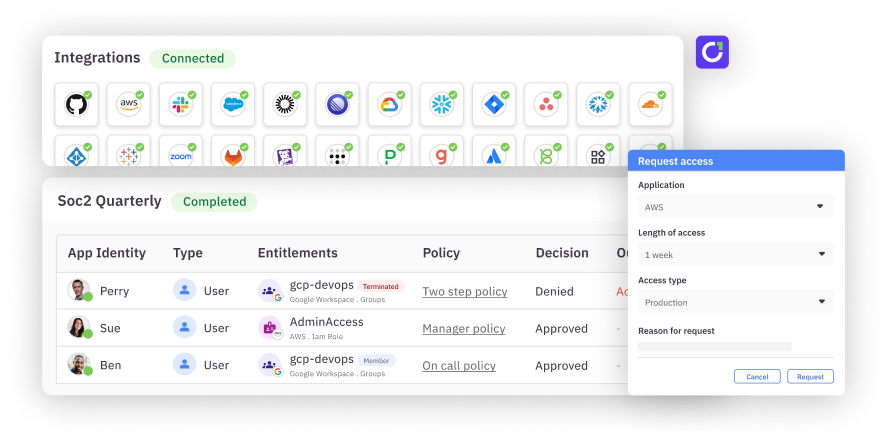
Reviews. Include agents in user access reviews. Owners should see what the agent can access, what it actually used, and when it last ran. High-risk agents, such as those with write access to financial or customer data, warrant quarterly or more frequent reviews.
Related regulations and frameworks#
No major regulation names "AI agent identity" yet, but existing access control requirements already apply to the accounts agents use.
| Regulation or framework | Why it applies to agent identities |
|---|---|
| SOX Section 404 (ITGCs) | Auditors test IT general controls, including access controls, under PCAOB AS 2201, the standard for auditing internal control over financial reporting. Agents that touch financially significant systems need approved, appropriate, and reviewed access, like any other account. |
| PCI DSS v4.0.1 | Requirement 8.6 covers system and application accounts, including how their credentials are managed and how their use is controlled. |
| NIST SP 800-53 Rev. 5 | AC-2 (account management) and AC-6 (least privilege) apply to every account type, human or not, and IA-9 covers identifying and authenticating services. NIST SP 800-171 Rev. 3 sets similar access control requirements for nonfederal organizations that handle controlled unclassified information, such as defense contractors and research universities. |
| GLBA Safeguards Rule | 16 CFR 314.4(c)(1) requires financial institutions to permit access only to authorized users and limit them to the customer information they need. An agent that reads or acts on customer data is an authorized user in practice and needs the same limits. |
| EU AI Act | Articles 12 and 14 require record-keeping and human oversight for high-risk AI systems. If an agent is part of one, you need to know which agent acted and who owns it. |
| ISO/IEC 42001 | The AI management system standard expects defined roles, responsibilities, and controls for AI systems. |
| HIPAA Security Rule | Agents that access ePHI fall under the access control and audit control standards (45 CFR 164.312(a) and (b)). |
For a deeper look at how teams put these controls in place, read our AI agent identity guide, or compare platforms in Best AI Agent Governance Tools.
FAQ#
What is AI agent identity?#
AI agent identity is the governed, non-human identity an AI agent uses to authenticate and act across systems. It includes the agent's own credentials, a human owner, task-scoped entitlements, a lifecycle, and access reviews.
Is an AI agent a non-human identity?#
In most cases, yes. AI agents are a type of non-human identity, alongside service accounts, API keys, OAuth apps, and workload identities. Some agents act on a person's delegated access instead of their own identity. Agents differ because they act autonomously and choose their own actions, so they need runtime authorization and a named owner.
What is the difference between an AI agent and a service account?#
A service account runs fixed, predictable calls for one integration. An AI agent plans and takes multi-step actions, can call new tools, and may act on behalf of a person. Both need governance, but agents need tighter scoping and per-action authorization.
Should AI agents use human credentials?#
No. Agents should not run on a person's login or personal API tokens. Use a dedicated agent identity, or delegated access that is tied to a specific person, limited in scope, and revocable, so every action is attributed to the agent and the person it acts for.
Who should own an AI agent identity?#
The person or team accountable for the agent's business purpose, usually the team that deployed it. The owner approves its access, reviews it periodically, and hands off ownership if they change roles.
Do AI agents need access reviews?#
Yes. Agents should be included in user access reviews, with usage data showing which entitlements they actually exercise. Unused or unowned agent access should be revoked.
How does C1.ai govern AI agent identities?#
C1.ai (formerly ConductorOne) is an IGA platform that governs AI agents and people on one identity platform. With C1 MCP Gateway, personal AI assistants act under their owner's identity, and enterprise agents run as C1 Service Principals with their own owner, roles, and access reviews. Each MCP tool call through the gateway is checked inline against policy, sensitive actions route to an approver before they run, and every call is logged with the initiator, parameters, governing policy, and outcome. Credentials stay in C1 Vault, and what an agent touched sits on the same audit log as what a person did.