
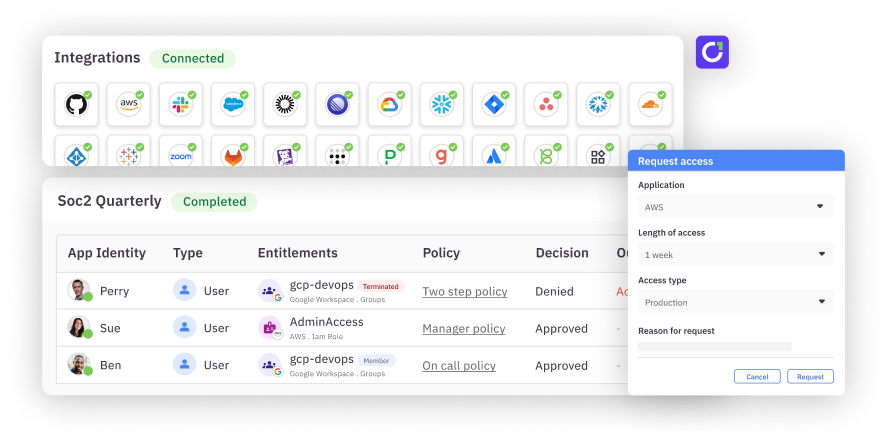
Separation of duties (SoD), also called segregation of duties, is an internal control that splits a sensitive process across two or more people or systems so no single identity controls two conflicting steps, such as initiating and approving a payment. It deters fraud, catches errors, and is a core control that auditors test under SOX and other frameworks.
The two names mean the same thing. "Segregation of duties" is the usual term in accounting, audit, and ISO/IEC 27001 (control 5.3). "Separation of duties" is the usual term in security standards such as NIST SP 800-53 (AC-5). Both are abbreviated SoD.
See how C1.ai enforces separation of duties
Why separation of duties matters: fraud, error, and SOX#
SoD does three jobs.
- Prevents fraud. In the ACFE’s 2026 study of 2,402 occupational fraud cases across 143 countries and territories, more than half occurred due to a lack of internal controls or an override of existing internal controls. The ACFE also estimates that organizations lose 5% of revenue a year to fraud (ACFE, 2026 Report to the Nations). Separating duties raises the bar: committing fraud then takes two people working together, which is harder to arrange.
- Catches errors. A second person reviewing a journal entry, a vendor change, or a production deploy catches honest mistakes before they reach the ledger or the customer.
- Supports SOX compliance. SOX Section 404(a) requires public companies to assess and report on internal control over financial reporting (ICFR), and Section 404(b) requires many of them to have their external auditor attest to that assessment. The statute doesn’t name separation of duties, but the COSO framework most companies use for ICFR does. Auditors test SoD as part of IT general controls (ITGCs) over access to ERP, payroll, and banking systems, and an unmitigated conflict can count as a control deficiency, a significant deficiency, or a material weakness, depending on severity.
How separation of duties works#
Most sensitive processes have four kinds of duty: authorize (approve the transaction), record (enter it in the system), custody (control the asset, such as cash or inventory), and reconcile or review (check that the records match reality). SoD gives these duties to different identities so each one checks the others.
In practice, you enforce SoD through access. In an identity governance and administration (IGA) program, each duty maps to entitlements in a system, such as an ERP role or a payroll permission. A conflict exists when one identity holds entitlements for two duties that your rules keep apart. Teams enforce SoD at three points:
- At request time (preventive). Check each request against SoD rules before granting access, then block it or route it for extra approval. For example, an AP clerk who can create vendors in the ERP requests the role that approves vendor payments.
- Continuously (detective). Scan existing access for conflicts, including ones created by role changes or by grants made directly in an app. For example, an admin adds a payroll specialist who can change employee bank details to the role that runs payroll.
- At review time. User access reviews let owners revoke conflicting access and record why they approved any exception. For example, a controller reviews every buyer in the procurement system who can also approve purchase orders.
Separation of duties examples by function#
| Function | System | Duty 1 | Duty 2 (keep separate) | Risk if one identity holds both |
|---|---|---|---|---|
| Finance | ERP (general ledger) | Create journal entries | Approve or post journal entries | Unreviewed entries that misstate results |
| Finance | ERP (AP) | Create or edit vendor master data | Approve or release vendor payments | Payments to a fake or altered vendor |
| Finance | Banking / treasury | Initiate wire transfers | Approve wire transfers | Unauthorized cash movement |
| Payroll | Payroll / HCM | Add employees or change bank details | Run or approve payroll | Ghost employees, diverted pay |
| Procurement | Procurement / ERP | Create purchase orders | Approve POs or record goods receipt | Purchases for personal benefit |
| HR | HRIS | Change compensation | Approve compensation changes | Unapproved raises |
| IT | IGA / directory | Request access | Approve the same access | Self-granted privileges |
| IT | CI/CD | Write code | Approve and deploy to production | Unreviewed changes to financial systems |
SOX auditors focus on the finance rows because they touch the numbers directly. The IT rows matter because they decide who can change the finance systems.
Segregation of duties matrix (free template)#
An SoD matrix lists duties on both axes and marks which pairs one identity must never hold together. It is the rulebook your access checks run against. Copy the template below into a spreadsheet, then replace the duties with the ones in your own ERP, payroll, procurement, and IT systems.
How to read the matrix: find the duty in the left column, then the duty across the top. The cell where they meet tells you if one identity can hold both.
- X: Conflict. Never combine.
- M: Allowed only with a documented mitigating control, such as a manager reviewing a monthly report.
- Blank: No conflict.
- —: Same duty.
| Duty | Create vendor | Initiate payment | Approve payment | Reconcile bank account | Create PO | Approve PO | Receive goods | Create journal entry | Approve/post journal entry | Change payroll data | Run payroll | Change code | Deploy to production | Administer user access |
|---|---|---|---|---|---|---|---|---|---|---|---|---|---|---|
| Create vendor | — | X | X | M | X | X | ||||||||
| Initiate payment | X | — | X | X | M | M | X | |||||||
| Approve payment | X | X | — | X | X | X | X | |||||||
| Reconcile bank account | X | X | — | M | X | |||||||||
| Create PO | M | M | X | — | X | X | X | |||||||
| Approve PO | X | X | — | M | X | |||||||||
| Receive goods | M | X | X | M | — | X | ||||||||
| Create journal entry | M | — | X | X | ||||||||||
| Approve/post journal entry | X | — | X | |||||||||||
| Change payroll data | — | X | X | |||||||||||
| Run payroll | X | — | X | |||||||||||
| Change code | — | X | X | |||||||||||
| Deploy to production | X | — | X | |||||||||||
| Administer user access | X | X | X | X | X | X | X | X | X | X | X | X | X | — |
The grid is symmetric, so you can read either half.
Two notes on the rows:
- Administer user access conflicts with every other duty, because whoever can grant access can give themselves any of them.
- Self-approval isn't shown as a pair: no one should approve their own access request, payment, or code change. Enforce that as a workflow rule in your request, payment, and deploy tools.
How to use it:
- Map duties to entitlements. For each duty, list the roles or permissions that grant it in each system (for example, an ERP role that can edit the vendor master).
- Assign owners. Each rule needs a business owner, usually the controller for finance rows and the system owner for IT rows.
- Run it against current access. Pull who holds each entitlement and flag every identity, human or machine, that hits an X.
- Remediate or document. Remove the conflict, or record the mitigating control and who approved the exception. Auditors will ask for both.
- Re-check on every change. Run the matrix again when roles change, apps are added, or people move teams.
Toxic combinations and how to detect them#
A toxic combination is a set of entitlements that is low risk on its own but risky together, like "create vendor" plus "approve payment." Most build up over time through:
- Privilege creep. A person changes roles and keeps the old access.
- Cross-app gaps. The vendor is created in the ERP and paid in a banking portal, so neither app sees the conflict on its own.
- Direct grants and emergency access. Access added in the app, or break-glass access that is never removed.
- Broad roles. One role bundles duties that should be split, so everyone in it holds a conflict.
How to detect them:
- Define rules once, centrally. Put your SoD matrix into your IGA platform as rules over entitlements, not per-app settings.
- Check every access request. Flag or route requests that would create a conflict before they are approved.
- Scan existing access continuously. Catch conflicts created outside the request flow.
- Review conflicts on their own. Scope access reviews to the identities with active conflicts, so reviewers spend their time on the risk.
- Keep the evidence. Log every conflict, decision, and exception so you can hand auditors a report instead of rebuilding it from screenshots.
C1.ai handles this with access conflict monitors: you define groups of mutually exclusive entitlements, and C1.ai flags existing and new conflicts, can route conflicting requests to a reviewer, scopes review campaigns to users with active conflicts, and keeps audit logs and downloadable reports.
You can also build automations in C1.ai that alert on or remediate specific risky combinations on a schedule.
Separation of duties for AI agents and non-human identities#
Most SoD rules were written for people. In finance and IT, AI agents, service accounts, bots, and API keys now do a growing share of the work. These non-human identities (NHIs) can hold the same toxic combinations, and they act faster and at higher volume than a person.
Three patterns to watch:
- An agent with both sides of a process. An AP agent that can create vendors and schedule payments has the same conflict as a clerk with both roles, and no one watches each step.
- An agent that inherits its owner's access. An agent that acts for a controller can use the controller's approval rights on transactions the controller never sees.
- An agent that approves its own requests. An agent that can request access and also approve or provision it removes the second person from the process.
How to apply SoD to agents and NHIs:
- Give every agent its own identity and owner. No shared credentials, and a named human accountable for each one.
- Run agents through the same SoD rules as people. The matrix applies to any identity that holds the entitlement.
- Keep a human approver on high-risk steps. Let an agent prepare a payment or journal entry, but require a person to approve it.
- Grant access just in time. Give agents scoped, time-bound access for a task instead of standing privileges.
- Include agents in access reviews. Review agent and service account access on the same cadence as the humans who own them.
In C1.ai, enterprise agents run as service principals with their own owner, roles, and access reviews. An agent acting for a person can get less access than that person, through just-in-time grants scoped to one task and revoked when it ends. At runtime, C1 MCP Gateway checks each tool call and sends sensitive actions to an approver before they run.
When one IGA model governs humans and agents, you maintain one SoD matrix, one set of conflict checks, and one audit trail.
Regulations and frameworks where separation of duties appears#
| Framework | Where SoD appears | What it means for access |
|---|---|---|
| SOX (404(a), 404(b)) | Management and auditors assess internal control over financial reporting; SoD is a core control tested within it | Auditors can report unmitigated conflicts in ERP, payroll, and banking access as deficiencies |
| COSO Internal Control framework (2013) | Principle 10 (control activities) includes the point of focus "Addresses segregation of duties" | The framework most SOX programs use to design controls |
| NIST SP 800-53 AC-5 | "Separation of Duties" control | Identify duties to separate and define access to support it |
| ISO/IEC 27001:2022 A.5.3 | "Segregation of duties" control | Separate conflicting duties and areas of responsibility |
| PCI DSS v4.0.1 6.5.4 | Roles separated between production and pre-production environments | Only reviewed, approved changes reach production |
| HIPAA Security Rule | Not named, but supported by information access management and workforce security safeguards | Separate who authorizes access to patient data from who uses it |
Separation of duties FAQ#
Is segregation of duties the same as separation of duties? Yes. Both terms describe the same control, and both are abbreviated SoD. Accounting, audit, and ISO 27001 tend to say "segregation"; NIST and many security teams say "separation."
What is an SoD conflict? An SoD conflict, or SoD violation, is when one identity holds two entitlements that your SoD rules say must be split, such as creating vendors and approving payments.
Does SOX require separation of duties? The SOX statute does not name SoD. Section 404(a) requires management to assess internal control over financial reporting, and Section 404(b) requires many companies to have their auditor attest to that assessment. The COSO framework behind most of those assessments includes segregation of duties. Auditors can report unmitigated conflicts as control deficiencies.
How does separation of duties relate to least privilege? Least privilege limits each identity to the access it needs. SoD adds a second rule: even needed access must not combine into a conflict. Most IGA programs enforce both.
What if our team is too small to separate every duty? Use mitigating controls. If one person must hold both duties, add an independent review, such as a manager checking a monthly vendor-change report, and document it in the SoD matrix.
Do AI agents need separation of duties? Yes. An agent that can both initiate and approve a transaction is a conflict, just like a person. Give each agent its own identity, run it through the same SoD rules, and keep a human approver on high-risk steps.
How does C1.ai help with separation of duties? C1.ai, formerly ConductorOne, has built the identity platform for the AI era. The C1.ai platform governs human and non-human identities in one place. Its access conflict monitors detect SoD violations across connected apps, can route conflicting requests to a reviewer, and produce reports for auditors. In access reviews, the C1.ai platform flags conflicts and recommends actions so reviewers can focus on the riskiest items.
Enforce separation of duties for every identity#
The C1 Identity Platform runs least privilege, separation of duties, access reviews, lifecycle, and auditing on one platform for humans, workloads, and agents. It turns your SoD matrix into conflict rules that check access requests, scan existing access, and keep the evidence auditors ask for. The same rules cover employees, contractors, and AI agents.