





Every enterprise I talk to has some version of the same assumption baked in: security is the thing that slows AI down. The review board. The approval queue. The CISO who says not yet. The friction between "we want to ship" and "we need to be safe."
I want to challenge that assumption directly. Not because security doesn't create friction — it does, when it's implemented wrong. But because security, implemented correctly, is what makes speed survivable. The safe path and the fast path are not in tension. They're the same path, if you build the substrate right.
The reframe: agency, not identity#
The old question the identity stack answered was "who is this?" Your existing tools do that well. Login, MFA, role assignment — built for humans, works for humans.
The new question is different. What is this allowed to do? On whose behalf? With what scope? For how long?
That's not identity. That's agency. And agency requires five things working together as one: identity plus permission plus delegation plus lifecycle plus revocation. Not five disconnected things stitched together with a service account and a .env file. One coherent substrate that answers all five at the moment of every tool call.
Four primitives the substrate has to deliver#
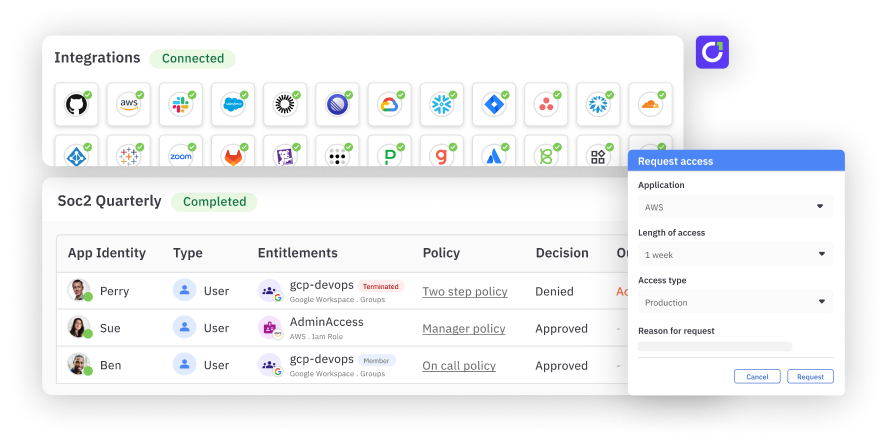
An identity-aware proxy sits in front of every tool call. Every action is authenticated, permission-checked, and logged in real time. Not batch. Not at the IdP. At the call.
Credential vaulting means service credentials never live on user laptops. Auto-rotation. Instant revoke. If a credential exists in a .env file somewhere, it is already compromised. You just don't know it yet.
Scope minimization means the default permission is empty. You add what's needed for the task; you don't subtract from a broad role. An agent that needs read access to one production table for thirty seconds should not inherit the same entitlements as the engineer who manages the entire database.
Revocation as a first-class operation means you can kill an agent, a chain, or a credential in one click. Not a multi-hour ops fire drill. One click.
Why this makes speed possible, not impossible#
Each of these primitives removes friction from the safe path. The identity-aware proxy means a request can be auto-approved at the moment of the call — no ticket queue, no async wait. Credential vaulting means an engineer doesn't manage secrets on their laptop, which is both more secure and less work. Scope minimization means agents get exactly what they need, immediately, without a review board deciding whether the scope is appropriate. Revocation as first-class means a security incident is a recovery operation that takes seconds, not a fire drill that takes hours.
The substrate makes the safe path faster than the unmanaged path. That's the claim. And it's defensible — not because I want it to be true, but because the primitives, deployed correctly, produce it.
The one invariant that never moves#
One human at the top of every agent chain. Accountability does not dilute across agent hops. If you can't answer who is responsible for this agent's actions, you cannot deploy the agent. This is not a philosophical position. It's the operational requirement that makes everything else governable.
An engineer asks a coding agent to ship a fix. The coding agent spawns a deployment agent. The deployment agent needs a scoped credential to touch a production secret. Three hops. Three identities. One human accountable. The substrate has to make that chain traceable all the way back, every time, without anyone having to manually stitch the log together.
That's what security as an enabler actually means. Not slowing things down until they're safe. Building the substrate so that fast and safe are the same answer.
Part six of a series based on the Agentic Adaptation Playbook. Previously: your engineers are building the same agent twelve times. Next: the 90-day blueprint — five concrete moves your existing people can make Monday morning.