


Welcome to C1 Deploy, our new launch series! We're shipping so much good stuff in C1.ai each week, it's hard for even us to keep up. C1 Deploy is our weekly moment to stop and shine a spotlight on new features we're especially hyped about.
This week we're highlighting one of our most in-demand new AI features: AI role mining.
Building roles is one of the least loved parts of governance. You start with a clean idea — a finite set of profiles that map to the work people do — and end up with a sprawling spreadsheet of entitlements, exception requests, and tribal knowledge. New hires get whatever the last person on the team had. Auditors ask why, and you don't have a great answer.
Role mining is supposed to fix this, but in practice it usually doesn't. Most IGA tools treat it as a one-time modeling engagement — long, manual, and built from directory attributes that don't reflect how people actually work. By the time the project finishes, the org has changed and the model is already drifting.
C1.ai just shipped a different approach. AI Role Mining analyzes the entitlements your users actually hold — across departments, applications, and teams — and surfaces suggested roles you can approve in a few clicks. No spreadsheets. No guesswork. No drift.
How it works#
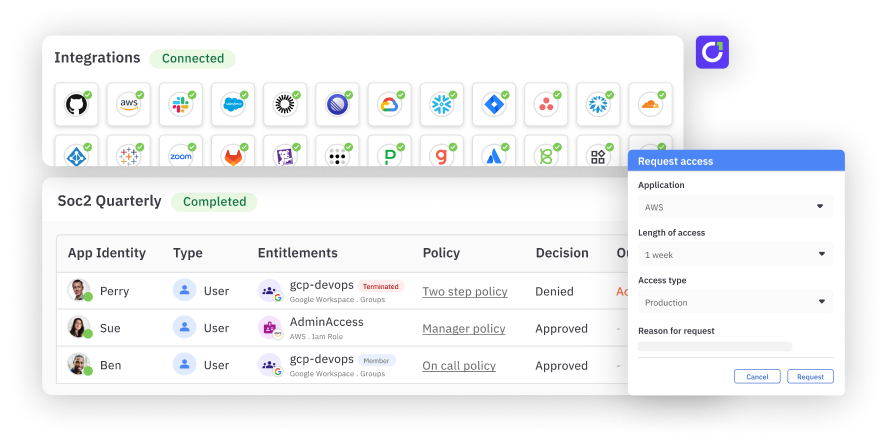
Our AI Role Mining analyzes real access patterns: who has what, how those people are grouped, what their peers share, and how those clusters change over time. That data is used to detect entitlement clusters worth formalizing — the access most engineers share, the apps every member of finance touches, the permissions that show up in 90% of a manager's team. Each cluster becomes a candidate role, ready to review and publish.
Approve a suggestion and it becomes an access profile available immediately in C1.ai — no rebuild step, no manual reconstruction, no separate tool.
Two ways to use it#
There are two paths for Role Mining, depending on what you want to do.
Suggestions surface automatically after each connector sync. As your environment changes, C1.ai watches for patterns and flags new clusters worth formalizing. This is the always-on path — useful for staying ahead of permission sprawl rather than catching up to it once a year.
Custom analysis lets you define a specific cohort and run an analysis on demand. A department, a job title, an employment status, a manager's team. C1.ai looks at that group's access and shows you what they share. Useful for targeted cleanup, onboarding standardization for a single team, or pre-audit rationalization.
Both paths lead to the same outcome: a suggested role, with the data behind it, ready for you to approve, edit, or reject.
Why this matters#
Role cleanup is one of those projects that sits on the IT roadmap for years. Important enough that everyone agrees it should happen. Painful enough that no one volunteers. AI Role Mining moves it from a periodic exercise to a continuous practice — your profiles stay accurate as your organization changes.
The downstream impact is real. Onboarding gets faster because new hires inherit a profile based on what their team actually uses, not a guess. Access requests get cleaner because users start from a defined baseline. Audits get easier because every role can be defended with the data that produced it.
C1.ai builds AI into every stage of the governance cycle, so you can accelerate data analysis and decision-making and keep moving at AI speed. This is what AI-native identity governance looks like at the role layer: real patterns, real data, real profiles you can stand behind. The next time onboarding kicks off or an auditor asks how a profile got built, the answer is the same — here's the cluster, here's the data, here's the decision.
To learn more about AI Role Mining, visit our docs or talk to our team!