

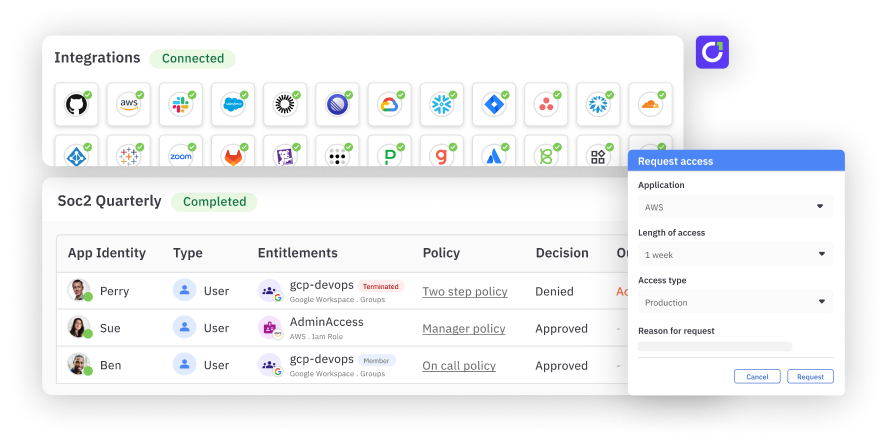
Zero standing privilege (ZSP) is the security principle of eliminating persistent access rights by granting users only the specific permissions they need, for only as long as they need them. ZSP reduces the attack surface by ensuring that even a fully compromised account cannot be used to reach systems the user has no immediate reason to access. Organizations implement ZSP through just-in-time access provisioning, least-privilege access controls, continuous access reviews, and automated lifecycle management.
Zero standing privilege (ZSP) refers to the principle of granting the minimum necessary level of access to a user or system, for the specific tasks they need to perform, and for no longer than required. Persistent, always-on access to sensitive systems is one of the most commonly exploited conditions in modern breaches. ZSP eliminates that liability by ensuring access is provisioned on demand and revoked automatically when the need ends. Regulatory frameworks including HIPAA, GLBA, and NIST all emphasize minimizing access to sensitive data. ZSP is closely related to zero trust, which extends the "never trust, always verify" posture across identity, device, and network layers.
Why ZSP matters#
Reduced attack surface: Users hold only the access they need at any given moment. An attacker who steals a credential gains only whatever narrow, temporary permissions were active at that instant.
Limited blast radius: When a breach does occur, the damage is bounded by the scope of the compromised account's access.
Minimized insider risk: Insider threats are constrained by the same access limits. A user cannot exfiltrate data from a system they cannot reach.
ZSP and least privilege#
Least privilege states that users and systems should hold only the minimum permissions required to perform their job functions. ZSP applies that principle dynamically: not only should access be minimal in scope, it should also be minimal in duration. Many organizations define least-privilege roles but then assign them permanently, creating standing access that accumulates over time. ZSP closes that gap by making time-bounded access the default, not the exception. Just-in-time (JIT) access is the operational mechanism through which ZSP is most commonly delivered.
How to implement ZSP#
Define roles and responsibilities: Map every user role to the specific resources and permissions required. This mapping becomes the foundation for all subsequent access decisions.
Apply policy-based access controls: Policy-based access controls (PBAC) grant permissions dynamically based on user attributes, role, context, and time.
Implement just-in-time provisioning: Users request access to sensitive resources when they need them. Access is granted for a defined window and revoked automatically at the end of that window. JIT access workflows make this operationally feasible at scale.
Automate continuous access reviews: Standing access that has not been explicitly renewed should trigger review or automatic revocation. Access reviews surface unused or inappropriate access before it becomes a liability.
Monitor anomalous access patterns: AI Access Management applies intelligence to access event data to identify risk signals that manual review would miss.
ZSP and non-human identities#
Service accounts, API keys, CI/CD credentials, and machine-to-machine integrations frequently accumulate standing access that was never revoked, and they're rarely included in standard access review cycles. Non-human identity (NHI) governance applies ZSP principles to machine credentials — documenting what each NHI is, what it can access, who owns it, and whether that access is still necessary.
ZSP and compliance#
- HIPAA: Requires limiting access to ePHI to users with a documented need. ZSP ensures access is time-bounded and scoped to specific tasks.
- GLBA: Requires protecting customer financial data from unauthorized access. ZSP limits the population of users with standing access at any given time.
- NIST SP 800-53: Includes explicit controls around least privilege and account management that ZSP satisfies.
How C1 enables zero standing privilege#
Just-in-time access workflows let users request temporary, scoped access through a self-service interface. Access is provisioned immediately upon approval and revoked automatically when the time window closes. Access reviews run continuous certification campaigns that identify accounts with access they no longer need. Automations handle the ongoing work of keeping access current without manual intervention. See also: Zero Trust, SSO, vendor privileged access, and identity governance best practices.