




Are you solving your identity governance challenges, or just reacting to symptoms?
There’s a lot of confusion in the market right now. I see it all the time: buyers lumping identity governance platforms and SaaS management platforms into the same category, assuming they’re interchangeable or that one can “just do both.”
On the surface, they seem related. Both give you visibility into your environment. Both talk about access. Some vendors even claim to offer both in one platform.
But let’s be clear: these are two entirely different tools solving two entirely different problems. One gives you insight into managing your SaaS contracts. The other is about securing your business and providing security-driven governance.
It’s the difference between reacting to symptoms and solving the root issue.
SMPs: A pretty dashboard for a broken process#
SaaS management platforms (SMPs) are designed to give you centralized visibility into app usage and spend. According to Gartner, their job is to “discover, manage, optimize and automate the SaaS application lifecycle.” Which, in plain English, means: track what you’re paying for, what’s being used, and try to reduce waste.
It’s not a bad idea. But it’s not identity governance.
SMPs tell you who has access to what SaaS product and maybe when they last used it. That’s helpful information for procurement or finance. It’s not a security solution. It won’t help you prevent a breach. It won’t clean up over-provisioned access. It won’t enforce least privilege. And it won’t give you the controls to do something meaningful with the data.
That’s what makes it a symptom chaser. You might learn you’re overspending, but you’ll still have no way to enforce policy or fix the underlying access problem.
Identity governance: the root of the problem#
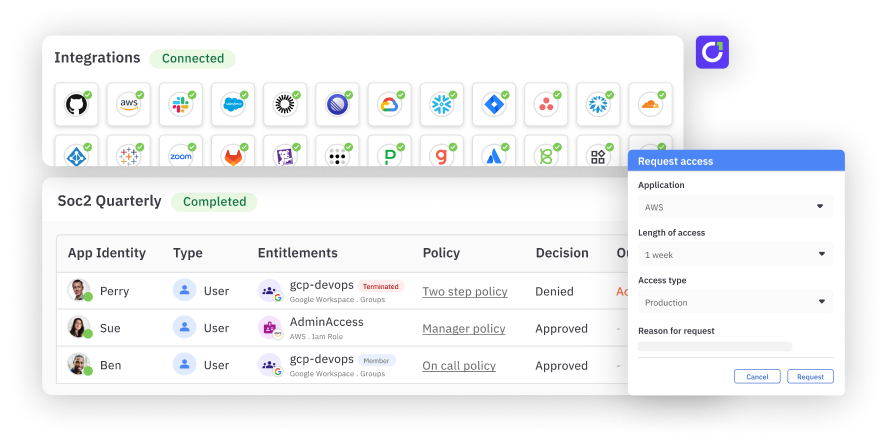
An identity governance platform does the real security work. It enforces access controls, manages entitlements, automates deprovisioning, and ensures there’s a clean, auditable record of who has access to what.
It doesn’t just tell you there’s a problem. It provides a solution.
If you’ve implemented strong governance, the “cost savings” dashboard starts to look a lot less important. Because you’ve already eliminated the real risk: excessive access, misconfigurations, and orphaned accounts.
SaaS spend visibility isn’t a substitute for access control. It’s just a side effect of doing identity right.
Why this confusion exists#
The reason SMPs exist is because organizations didn’t have a handle on vendor management or identity governance. So, they reached for a point solution that could shine a light on the chaos.
That maybe made sense ten years ago. But now, identity is a security problem. It’s a strategic function that requires depth, and no one platform can go deep on both SaaS cost management and identity governance. If it tries, it usually ends up doing neither well.
So if you need a tool to manage contracts or track app usage, go buy that. But don’t expect it to solve your security problems. And don’t call it identity governance.
SaaS cost models are changing#
Here’s another reason this matters: SaaS cost models are changing. We’re moving away from per-user pricing toward compute-based or usage-based models, especially with the rise of AI workloads.
That means tracking license utilization per user is becoming irrelevant. If your “identity strategy” is rooted in showing per-user license savings, you’re building a program on a foundation that’s already eroding.
The teams that win in the future will be the ones focused on securing every identity—human, non-human, agentic—regardless of how the app is priced.
Know what problem you're solving#
If you’re spending time comparing identity governance platforms and SaaS management tools, ask yourself this: are you solving a root cause, or just chasing a symptom?
A governance platform secures your business. An SMP gives you a dashboard. One keeps your auditors and security team happy. The other makes your CFO feel warm and fuzzy (until the next breach).